
Choosing the right material for furniture is one of the most important decisions when designing or renovating a home. Whether you are planning a wardrobe, kitchen cabinets, bedroom furniture, TV console, shelving, or custom storage, the material used can affect its appearance, durability, cost, and performance over time.
In Pakistan, MDF, plywood, and particle board are among the most commonly used engineered wood materials in furniture and interior projects. Although they may look similar after laminating or finishing, each material has different characteristics, strengths, limitations, and ideal applications.
At Spaces & Places, we believe good interior design combines aesthetics, functionality, and thoughtful material selection. Understanding the differences between MDF, plywood, and particle board can help homeowners make more informed decisions before investing in furniture or interior work.
In this guide, we will compare these three materials, explain where each one works best, and help you choose the right option for your home.
What Are MDF, Plywood, and Particle Board?
MDF, plywood, and particle board are engineered wood products manufactured using wood fibres, veneers, or particles combined with adhesives and processed into boards. They are widely used in furniture manufacturing because they provide different combinations of affordability, strength, smoothness, and design flexibility.
What Is MDF?
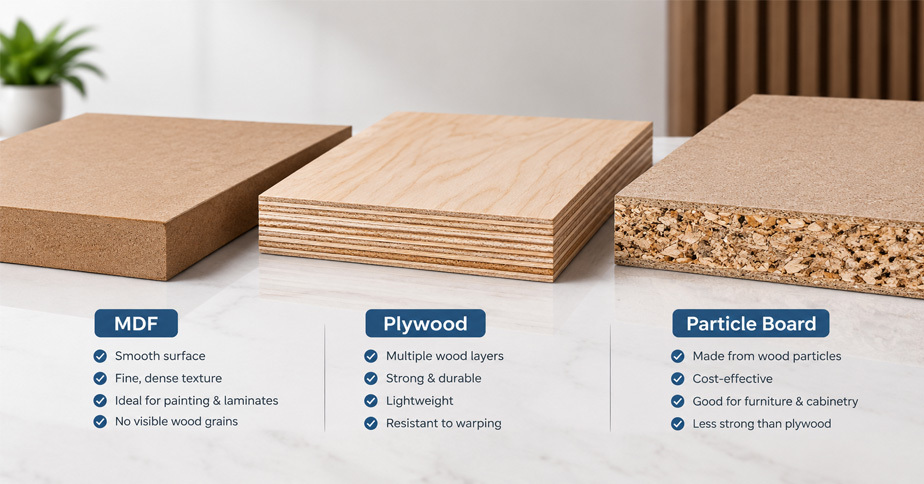
MDF stands for Medium Density Fibreboard. It is manufactured by combining fine wood fibres with resin and compressing them under heat and pressure to create a dense, smooth board.
Because MDF has a relatively uniform surface, it is commonly used for painted furniture, decorative panels, wardrobe shutters, dressing tables, and furniture with detailed designs.
What Is Plywood?
Plywood is made by bonding multiple thin layers of wood veneer together. These layers are generally arranged with their grain directions alternating, which helps improve the board’s stability and strength.
Plywood is often used in furniture components where strength, screw holding, and structural performance are important.
What Is Particle Board?
Particle board, also known as chipboard, is made from wood particles, chips, or other wood residues bonded together using adhesives and pressed into boards.
It is generally an economical option and is commonly used in budget furniture, laminated cabinets, shelving, and furniture components where the material is not exposed to excessive moisture or heavy loads.
MDF: Advantages, Disadvantages, and Best Uses
MDF is popular in interior design because of its smooth surface and versatility. It is particularly suitable for furniture that requires painted finishes, decorative details, or a clean and uniform appearance.
Advantages of MDF
- Smooth and uniform surface
- Suitable for painted finishes
- Easy to cut and shape
- Good for decorative profiles and detailing
- Generally provides a consistent appearance
- Useful for modern and contemporary furniture designs
Disadvantages of MDF
- Standard MDF is vulnerable to moisture
- Can swell if exposed to water
- Generally heavier than some alternatives
- Screw holding may be weaker near edges
- Damaged MDF can be difficult to repair
- Requires suitable protection and finishing
Where Is MDF Best Used?
MDF is commonly suitable for:
- Painted wardrobe shutters
- Dressing tables
- TV units
- Decorative wall panels
- Bedroom furniture
- Interior decorative elements
- Furniture with routed or detailed designs
For example, MDF can be a suitable choice for a wardrobe with a smooth painted finish or a decorative TV wall where the visual appearance is more important than structural loading.
Plywood: Advantages, Disadvantages, and Best Uses
Plywood is generally selected when strength, stability, and durability are important considerations. Its layered construction makes it suitable for many furniture applications, although performance depends on its quality, grade, thickness, and manufacturing standards.
Advantages of Plywood
- Generally stronger than standard MDF and particle board in many applications
- Better screw-holding capability in suitable grades
- Suitable for furniture structures and cabinets
- Available in different thicknesses and grades
- Can be used for a variety of furniture applications
- Certain grades offer improved moisture resistance
Disadvantages of Plywood
- Quality varies considerably between manufacturers
- Higher-quality plywood may cost more
- Surface may require additional finishing
- Edges may need treatment or covering
- Lower-quality plywood can contain voids or defects
Where Is Plywood Best Used?
Plywood is commonly used for:
- Kitchen cabinet carcasses
- Wardrobe structures
- Bed frames and furniture structures
- Heavy-duty shelves
- Storage cabinets
- Furniture requiring stronger joints
- Applications where better structural performance is needed
For furniture that will support weight or experience frequent use, plywood may be a practical option when the appropriate grade and thickness are selected.
Particle Board: Advantages, Disadvantages, and Best Uses
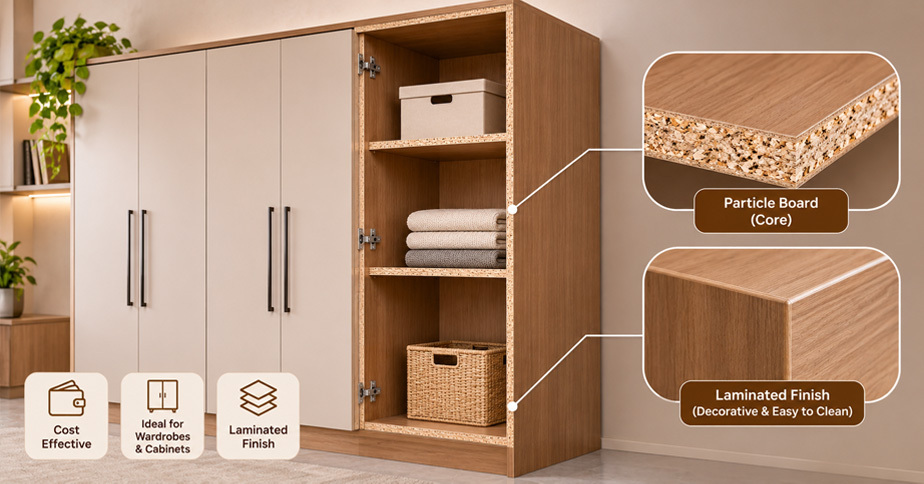
Particle board is often selected for economical furniture solutions. It is widely available in laminated form and can provide a clean appearance at a comparatively lower cost.
Advantages of Particle Board
- Generally more economical
- Available in laminated and decorative finishes
- Suitable for many basic furniture applications
- Provides a uniform board surface
- Useful for budget-conscious furniture projects
Disadvantages of Particle Board
- Generally less suitable for heavy loads than stronger alternatives
- Moisture can cause swelling and damage
- Screw holding may be limited, especially near edges
- Damaged areas may be difficult to repair
- Long-term performance depends heavily on quality and usage conditions
Where Is Particle Board Best Used?
Particle board is commonly used for:
- Budget wardrobes
- Laminated furniture
- Basic shelves
- Office furniture
- Decorative furniture components
- Furniture used in relatively dry conditions
For furniture that will be used lightly and maintained properly, particle board can be a cost-effective option.
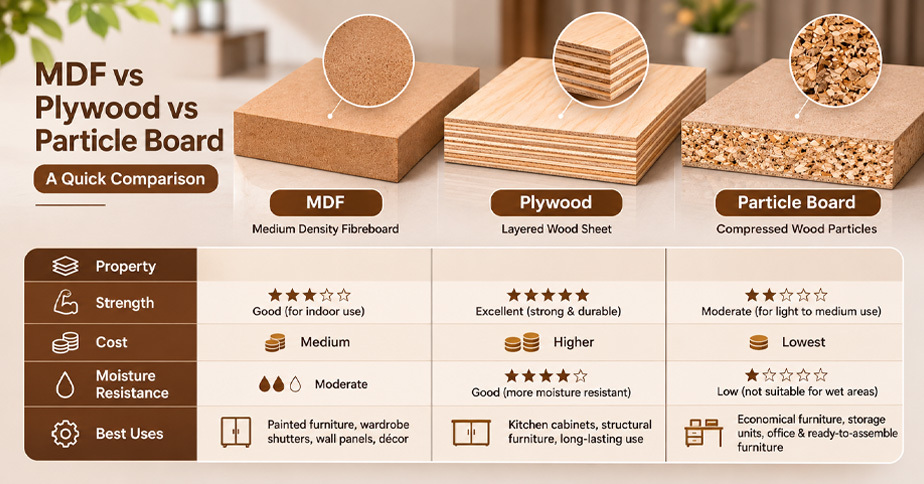
MDF vs Plywood vs Particle Board: Comparison
| Feature | MDF | Plywood | Particle Board |
| Manufacturing | Wood fibres | Thin wood veneers | Wood particles/chips |
| Surface | Smooth and uniform | Depends on veneer and grade | Generally uniform |
| Strength | Moderate | Generally stronger | Generally lower |
| Screw holding | Moderate | Generally better | Often limited |
| Painted finish | Excellent | Requires suitable preparation | Usually laminated or finished |
| Decorative detailing | Very suitable | Less suitable for fine routing | Limited |
| Moisture resistance | Low in standard MDF | Depends on grade | Generally low |
| Weight | Often heavy | Varies by type | Varies |
| Cost | Moderate | Can be higher | Usually economical |
| Best use | Painted and decorative furniture | Structural furniture and cabinets | Budget laminated furniture |
Actual performance depends on board quality, grade, thickness, construction, hardware, finishing, and environmental conditions.
MDF vs Plywood: Which Is Better?
MDF and plywood are frequently compared because both are used in custom furniture, wardrobes, kitchen cabinets, and interior applications.
The better choice depends on what you need from the furniture.
Choose MDF When:
- You want a smooth painted finish
- The furniture includes decorative details
- You need a uniform surface
- The design includes routed panels or shapes
- The furniture is primarily decorative or used in suitable indoor conditions
Choose Plywood When:
- Strength is a priority
- The furniture will support heavier loads
- Better screw holding is required
- You are making cabinet structures
- The furniture is expected to experience frequent use
For many projects, MDF and plywood can also be combined. MDF may be used for decorative shutters or panels, while plywood is used for structural components.
MDF vs Particle Board: Which Is Better?
MDF and particle board are both commonly used for economical furniture, but their applications can differ.
MDF generally offers a smoother and more uniform surface, making it suitable for painted furniture and decorative designs.
Particle board is often more economical and is commonly used in laminated furniture where the board’s appearance is provided by the laminate rather than a painted finish.
MDF Is Better for:
- Painted furniture
- Decorative shutters
- Smooth panels
- Detailed designs
- Furniture requiring a uniform surface
Particle Board Is Better for:
- Budget furniture
- Basic laminated cabinets
- Economical storage units
- Furniture used in dry indoor environments
The final decision should also consider the quality of hardware, edge banding, construction method, and installation.
Which Material Is Best for Wardrobes?
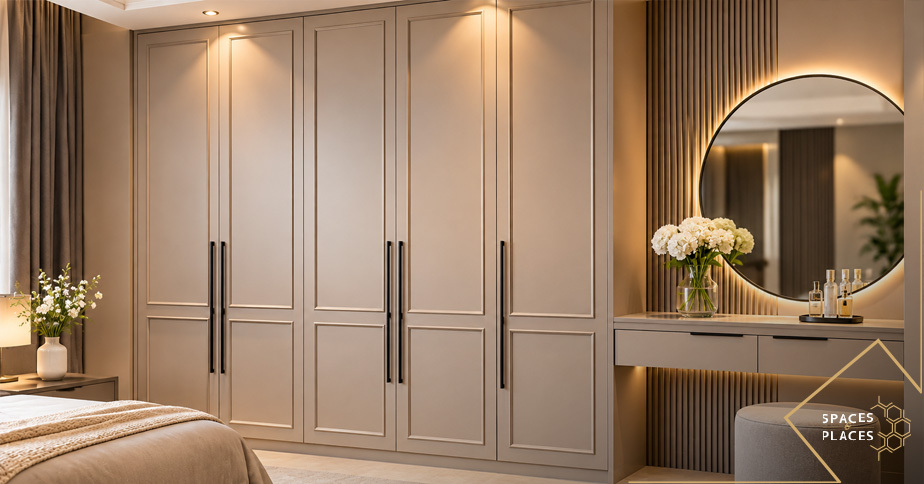
Wardrobes are among the most common furniture applications for MDF, plywood, and particle board.
The ideal material depends on the wardrobe design, budget, usage, and finish.
For Painted Wardrobe Shutters
MDF can be a suitable choice because of its smooth surface and ability to accommodate painted finishes.
For Wardrobe Structure
Plywood may be preferred for components where strength and durability are important, particularly in wardrobes with heavier storage requirements.
For Budget Laminated Wardrobes
Particle board can be an economical choice when used with suitable laminate, edge banding, hardware, and proper installation.
A well-designed wardrobe is not only about selecting the board. Its internal layout, hanging sections, drawers, shelves, hardware, ventilation, and overall construction also play an important role in performance.
Which Material Is Best for Kitchen Cabinets?
Kitchen cabinets experience more frequent use and may be exposed to humidity, spills, heat, and cleaning products. Material selection should therefore be more carefully considered.
Plywood for Kitchen Cabinet Structures
Suitable plywood grades may be considered for cabinet structures where strength and durability are important.
MDF for Kitchen Cabinet Doors
MDF may be suitable for cabinet doors and decorative panels when properly finished and protected from moisture.
Particle Board for Economical Kitchens
Particle board may be used in budget kitchen applications, particularly where quality laminates and proper edge protection are provided.
However, standard MDF and particle board should not be assumed to be waterproof. Moisture-resistant products may offer improved performance in suitable conditions, but they still require proper installation and protection.
Which Material Lasts Longer?
Durability depends on several factors, including:
- Board quality
- Thickness
- Material grade
- Construction technique
- Hardware quality
- Edge protection
- Installation
- Moisture exposure
- Maintenance
Plywood may provide better structural performance in many applications, while MDF can perform well in decorative and painted furniture when properly protected.
Particle board can also perform satisfactorily in suitable dry conditions, particularly when the furniture is manufactured and installed correctly.
The material alone does not determine the lifespan of furniture. Poor workmanship, unsuitable hardware, water exposure, and incorrect installation can damage furniture made from any board.
Which Material Is More Affordable in Pakistan?
Furniture material costs can vary depending on the manufacturer, board thickness, grade, brand, finish, availability, and market conditions.
Generally:
- Particle board is often the economical option.
- MDF may offer a balance between cost and finish quality.
- Plywood may cost more depending on its grade and quality.
However, comparing only the price of the board can be misleading.
A complete furniture cost also includes:
- Laminate or paint
- Edge banding
- Hardware
- Hinges
- Drawer channels
- Cutting and fabrication
- Labour
- Installation
- Transportation
For this reason, homeowners should compare complete furniture specifications rather than selecting a material based only on its initial price.
How to Choose the Right Furniture Material
Before selecting MDF, plywood, or particle board, consider the following factors.
Your Budget
Determine how much you can allocate to furniture without compromising essential requirements.
Furniture Usage
Consider whether the furniture will be used occasionally, daily, or heavily.
Moisture Exposure
Kitchen cabinets, bathroom storage, and areas near water require more careful material selection and protection.
Required Finish
Painted furniture may benefit from MDF, while laminated furniture can use different board options depending on the design and budget.
Structural Requirements
Furniture supporting heavy loads or requiring strong joints may need a more suitable structural material.
Hardware and Construction
Good hinges, drawer channels, joints, edge banding, and proper installation are equally important for furniture performance.
Can Different Materials Be Used in the Same Furniture?
Yes. In fact, combining materials can often provide a more practical and economical solution.
For example:
- Plywood for cabinet structures
- MDF for painted shutters
- Particle board for economical laminated components
- Solid wood for selected decorative details
This approach allows designers and furniture manufacturers to use each material where it performs best instead of using one material for every component.
Material selection is an important part of the overall design process, and homeowners can explore the wider planning approach in our guide to interior design services in Lahore.
Common Mistakes to Avoid When Selecting Furniture Materials
Choosing Only Based on Price
The cheapest material may not always provide the best value if the furniture requires frequent repairs or replacement.
Ignoring Moisture Protection
Standard engineered wood boards are not waterproof. Proper protection is especially important in kitchens, bathrooms, and other areas where moisture may be present.
Using the Wrong Material for Heavy Loads
Shelves, cabinet structures, and furniture supporting heavy items require suitable thickness, construction, and material selection.
Ignoring Edge Finishing
Poor edge protection can affect the appearance and durability of furniture, particularly in laminated boards.
Selecting Material Without Considering the Design
The material should match the intended finish, style, functionality, and overall design concept.
Natural materials, wood textures, and carefully selected finishes can also influence the appearance of furniture and interiors, as discussed in our guide to latest interior design trends shaping Lahore homes.
Why Material Selection Matters in Interior Design
Furniture materials affect more than durability. They also influence the visual character of a home.
The texture, colour, finish, edge detailing, and proportions of furniture can help create a cohesive interior. A material that works well in one room may not be suitable for another.
Professional residential interior design considers furniture requirements, storage, layouts, lighting, materials, and finishes together rather than treating each decision separately.
Before finalizing furniture or interior materials, homeowners should also understand their requirements, budget, and priorities. Our guide Your Dream Home Starts With the Right Questions can help you think through the planning process.
Final Thoughts
MDF, plywood, and particle board each have their own advantages and limitations. There is no single material that is best for every furniture application.
MDF is often a suitable choice for smooth painted finishes and decorative furniture. Plywood may be preferable for structural components where strength and durability are important. Particle board can offer an economical solution for suitable laminated furniture applications.
The best choice depends on your furniture design, budget, usage, environment, finish, and construction quality.
Good interior design is not about choosing the most expensive material. It is about selecting the right material for the right application and ensuring that it works with the overall design and functionality of the space.
With thoughtful planning and professional guidance, homeowners can create furniture that looks beautiful, performs well, and provides long-term value.
Frequently Asked Questions
Is MDF better than plywood?
MDF is generally better for smooth painted finishes and decorative detailing, while plywood may be better for structural applications requiring strength and suitable screw holding. The best choice depends on the application.
Is MDF waterproof?
Standard MDF is not waterproof and can swell when exposed to moisture. Moisture-resistant MDF may offer improved resistance but should not be considered completely waterproof.
Is particle board good for furniture?
Particle board can be suitable for economical laminated furniture, basic storage units, and other applications in dry indoor conditions when properly manufactured and installed.
Which material is best for kitchen cabinets?
The best material depends on the cabinet component, budget, moisture exposure, and construction requirements. Suitable plywood may be used for cabinet structures, while MDF or other materials may be suitable for doors and decorative components.
Which material is best for wardrobes?
MDF can be suitable for painted wardrobe shutters, plywood may be useful for structural components, and particle board can be an economical option for laminated wardrobes. The final choice depends on the design and usage.
Which material is the cheapest?
Particle board is often the most economical option, although prices vary according to thickness, quality, brand, finish, and market conditions.
Can MDF and plywood be used together?
Yes. Combining MDF and plywood can be a practical approach. Plywood can be used for structural components while MDF is used for decorative or painted elements.
How can I make engineered wood furniture last longer?
Use suitable materials for each application, protect edges from moisture, use quality hardware, avoid excessive loading, ensure proper installation, and maintain the furniture according to its finish and material.